Vishwaroopa

Vishwaroopa (Viśvarūpa), also known as the Universal Form, is the infinite and all-encompassing manifestation of Lord Vishnu, particularly seen in His incarnation as Lord Krishna in the Bhagavad Gita. It is a grand revelation of the Supreme Being's transcendental nature—beyond human comprehension, time, space, and form.
  • The word "Vishwaroopa" is derived from "Vishwa" meaning the universe, and "Roopa" meaning form—together meaning "One who assumes the form of the entire Universe".
  • It symbolizes the Supreme God manifesting as everything that exists—all beings, all directions, all elements, and all forces of nature.

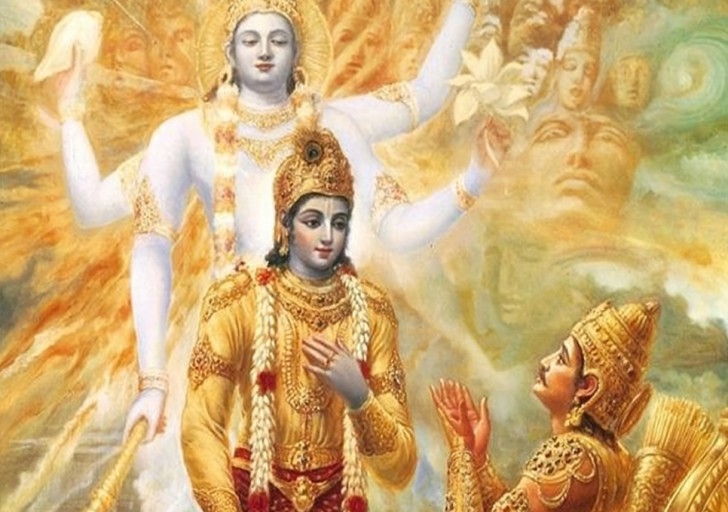
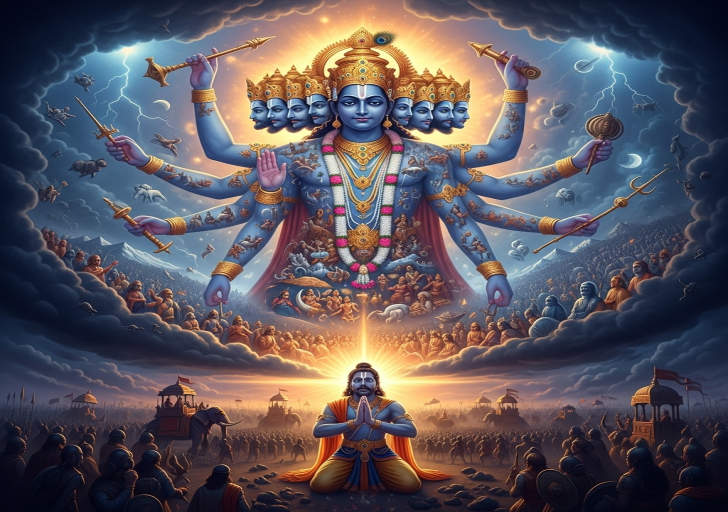
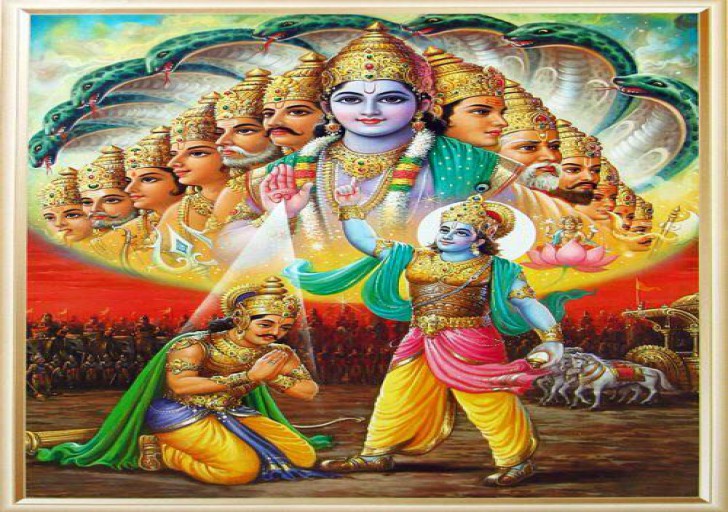
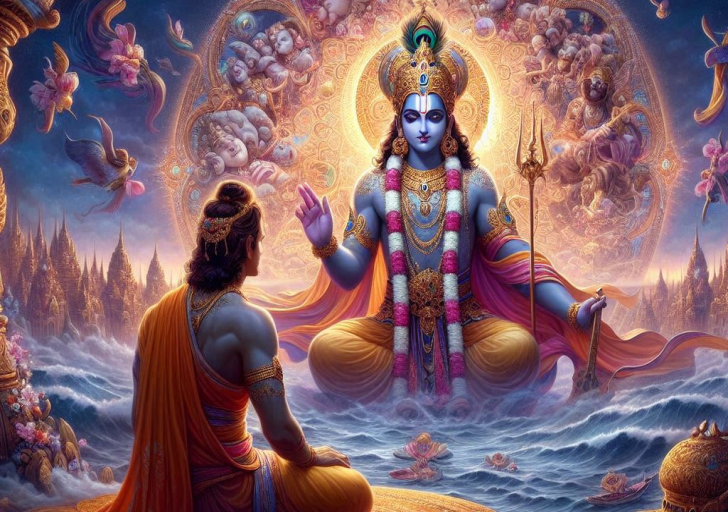
The most profound description of Vishwaroopa is found in the 11th Chapter of the Bhagavad Gita, where Lord Krishna reveals His cosmic form to Arjuna on the battlefield of Kurukshetra:

  • Arjuna, overwhelmed with confusion and grief at the thought of fighting his kin, seeks divine clarity.
  • In response, Lord Krishna grants Arjuna divine vision (Divya Drishti) and reveals His Vishwaroopa—a form with countless faces, arms, weapons, and eyes, blazing like a thousand suns rising simultaneously.
  • In this form, Arjuna beholds the entire universe, including gods, sages, demons, elements, past, present, and future, all residing within the body of the Lord.
  • He witnesses all warriors entering the Lord's mouth—symbolizing that creation and destruction are within the Lord's will.

This divine form is so majestic, terrifying, and brilliant, that Arjuna trembles in awe and fear, ultimately surrendering himself completely to Krishna's divine will.
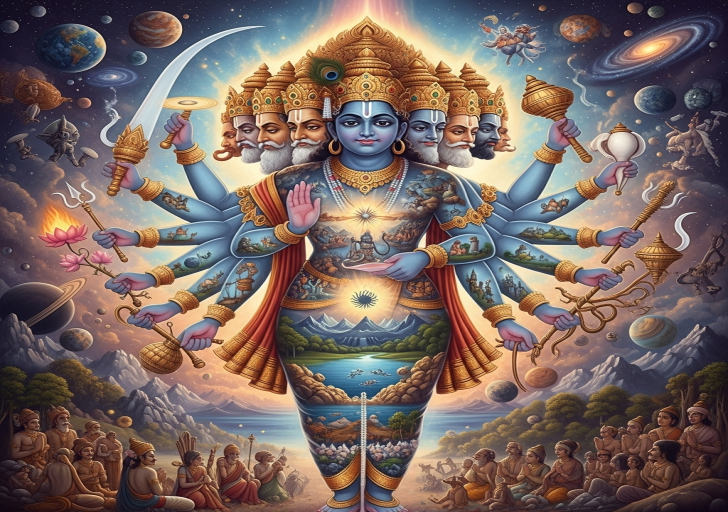
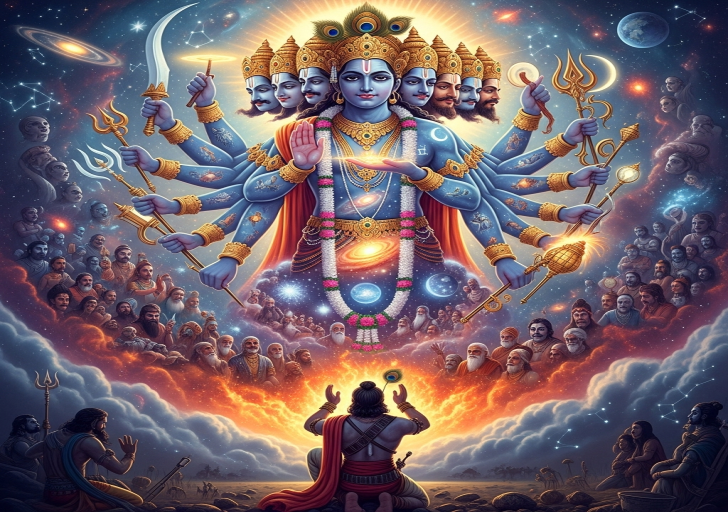
  • Oneness of Existence: Vishwaroopa represents the unity of all creation. Every being and every object is a part of the Supreme—there is no separation.
  • Timelessness: It shows the Supreme as beyond birth and death, transcending time. All that has happened, is happening, and will happen is encompassed in Him.
  • Divine Power of Creation and Destruction: The form reveals that Brahma (the Creator), Vishnu (the Preserver), and Shiva (the Destroyer) are not separate gods but facets of the same Supreme Consciousness.
  • Omnipresence and Omnipotence: Vishwaroopa signifies that God is present in every atom, every being, and every element of the universe, simultaneously.
  • Bhakti and Surrender: Arjuna's experience teaches that intellectual understanding is not enough—one must surrender with humility to grasp the Divine's true nature.
  • Infinite Arms and Faces: Signifying boundless abilities and universal presence.
  • Eyes Like Suns and Moons: Reflecting omniscience and divine illumination.
  • Garlands of Celestial Flowers and Fragrance: Symbolizing the blissful aspect of divine grace.
  • Weapons in Countless Hands: Representing the power to uphold dharma and destroy adharma.
  • Cosmic Fire from the Mouth: A metaphor for transformative energy and the ultimate dissolution (Pralaya).
  • All Creatures Entering the Divine Mouth: Indicating the Lord's role as the end-destination of all beings.

Though the Bhagavad Gita gives the most detailed vision, Vishwaroopa is acknowledged in various other scriptures:

  • Vishnu Purana and Bhagavata Purana describe cosmic manifestations of Lord Vishnu in the form of Virat Purusha, where the universe is visualized as His body.
  • Upanishads refer to the Purusha Sukta, describing the Supreme Cosmic Person whose thousand heads, eyes, and feet extend across all realms.

In temples, Vishwaroopa sculptures or idols serve as spiritual tools to visualize the infinite nature of God. The Vishwaroopa Darshan inspires awe, devotion, and spiritual introspection, reminding devotees of the insignificance of ego and the grandeur of divine order.
  • Spiritual Awakening: Realizing that the universe is not separate from the divine transforms one's perspective from ego-centric to God-centric.
  • Letting Go of Fear: The form teaches us that birth, life, and death are part of a divine plan, encouraging surrender and acceptance.
  • Encouraging Dharma: Just as Arjuna was reminded of his duty, Vishwaroopa teaches us to rise above confusion and follow righteousness with faith.
  • Unity in Diversity: The form is a message that despite external differences, everything is interconnected, originating from and returning to the same source.

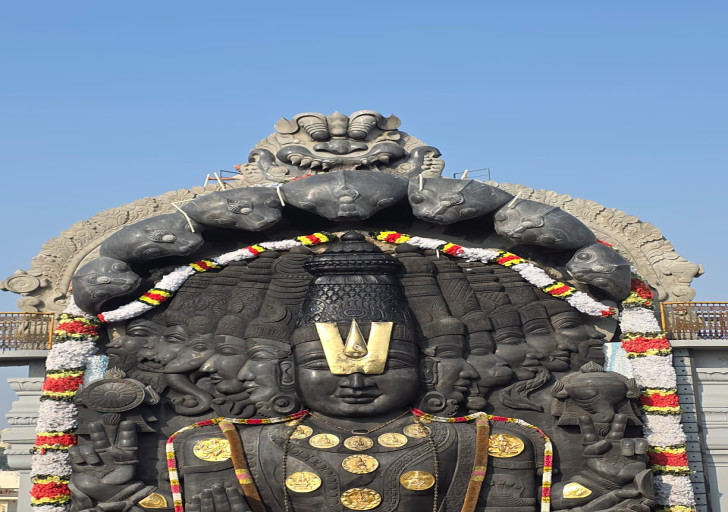
Maha Vishnu Vishwaroopa – Ejipura, Bangalore 47

Maha Vishnu Vishwaroopa at Ejipura, Bangalore – 47 is a sacred and spiritually vibrant divine form that represents the cosmic universal form of Lord Vishnu. “Vishwaroopa” means the all-encompassing universal form in which the Supreme Lord reveals His infinite power, compassion, and divine glory.

In this holy kshetram, devotees experience deep peace and spiritual energy by offering prayers to Sri Maha Vishnu in His Vishwaroopa Swaroopa. This divine form symbolizes protection, dharma (righteousness), and the preservation of the universe. The temple stands as a beacon of devotion, attracting bhaktas from different parts of Bangalore and beyond.

Daily poojas, Abhishekam, Alankara, deepotsava celebrations, and special homas are performed here, creating a highly charged spiritual atmosphere. Worshipping here is believed to bring prosperity, good health, peace of mind, and moksha krupa.

The sacred presence of Maha Vishnu Vishwaroopa at Ejipura inspires devotees to walk the path of truth, devotion, and surrender to the divine.

“Om Namo Bhagavate Vasudevaya”
Vishwaroopa is not merely a grand vision—it is a spiritual truth that reminds us of the eternal, boundless, and compassionate nature of the Divine. It invites every soul to realize that God is not far or separate, but immanent in every aspect of life, urging us to live with awareness, humility, and devotion.

To stand before Vishwaroopa is to stand before the entirety of creation, and in that moment, all boundaries dissolve—leaving only the Divine. Temple-Routine